• Judge Robinson’s Latest “Gift”: A 44% Hike in Health Insurance Premiums

    Judge Robinson’s Latest “Gift”: A 44% Hike in Health Insurance Premiums

    Yet again, it’s a great day to be a county employee. Our County Judge is the gift that keeps on giving.

    The County just released the health insurance premiums for next year, and let’s just say they’re staggering.

    You can see the chart full of numbers below, but I’ll summarize the damage here. In 2026, a Jefferson County employee with individual coverage will go from paying $79.97 per pay period to $115.37. That’s a 44% increase!

    Family insurance is “only” going up 11%. Lucky them, right? No, that’s because the County has already squeezed every last cent out of our families. It’s going from $818.47 per check to $907.72. That is $21,785.28 a year just for health insurance!

    Major corporate benefits consultant Mercer estimates that “the total health benefit cost per employee is expected to rise 6.5% on average in 2026 – the highest increase since 2010.” Wow, wouldn’t a 6.5% increase be great right about now?

    The Kaiser Family Foundation’s Employer Health Benefits Survey shows that the average US employee with individual coverage pays $1,440 per year ($120/month) out of pocket. In Jefferson County, we are being asked to pay $2,770 per year ($230/month)! How is a discrepancy this huge even possible?

    The company responsible for “negotiating” our health benefits, iOne Benefits Group, Inc. of Southaven, MS, states on their LinkedIn page: “We deliver employee benefit packages and solutions that enhance benefits and increase retention… IBG’s team of Account Managers offer day to day support to you, your HR team, employees, and their families.”

    I’m having a hard time finding a single shred of truth in that mission.

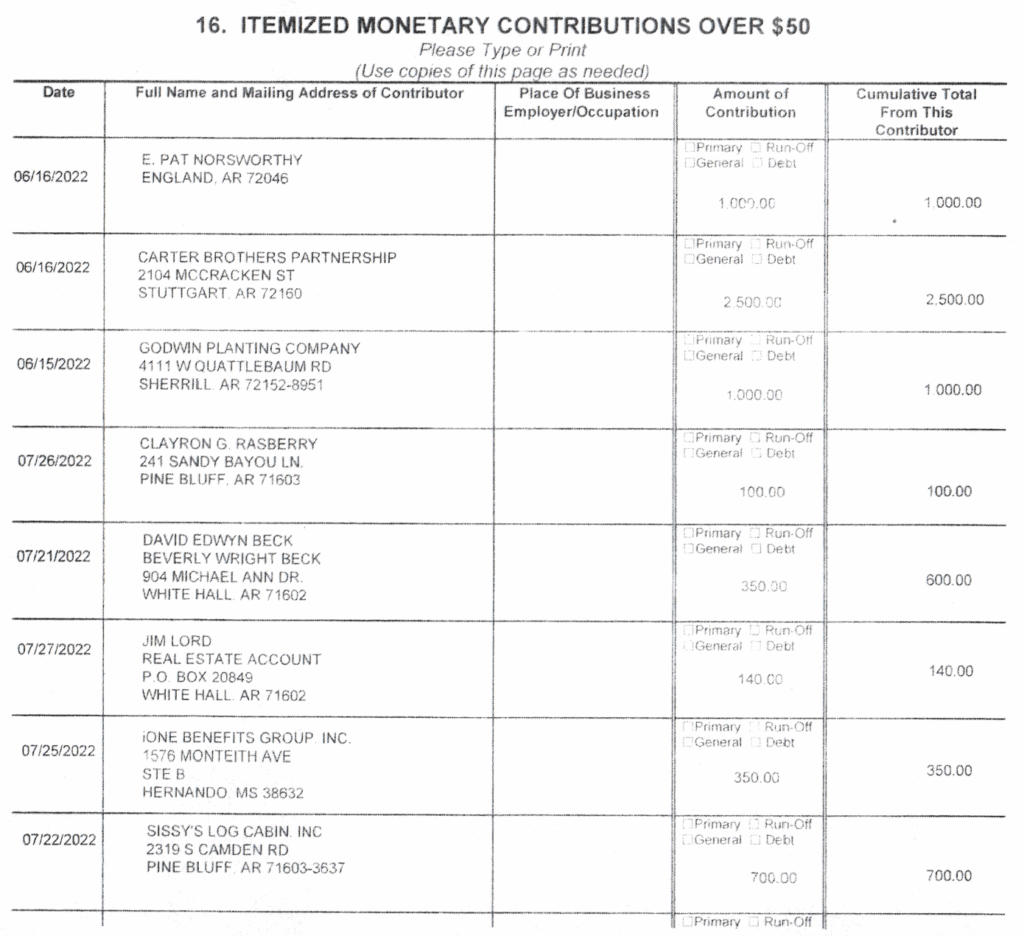
    One thing I do know about iOne Benefits is that they don’t mind buying a little favor with local governments. They donated $350 to the County Judge’s election campaign in 2022. It’s amazing how cheap it is to buy a politician these days.

    As far as I can tell, no effort has been made by the County Judge to find us better pricing, a better provider, or even for the County to help absorb some of this cost. There has been no mention of any of it to the Quorum Court. In fact, I didn’t know how dire the situation was until I received the Review of Benefits yesterday.

    County Employees, make your voices heard. It’s not the first time this year Judge Robinson has failed us. He thought he could get away without paying us, and it cost him $50,000 for that lesson. Now he’s making caring for our families unaffordable.

    This cannot stand.

    Sources:
    Employers are bracing for the highest health benefit cost increase in 15 years, a projected 6.5% increase in 2026, according to Mercer (Employers are bracing for the highest health benefit cost increase in 15 years, a projected 6.5% increase in 2026, according to Mercer)
    2025 Employer Health Benefits Survey (https://www.kff.org/health-costs/2025-employer-health-benefits-survey/#:~:text=The%20average%20annual%20contribution%20amounts,than%20the%20amount%20last%20year.)
    iOne Benefits Group, Inc (https://www.linkedin.com/company/ionebenefits/)

  • Irresponsible County Judge Spends Irresponsibly

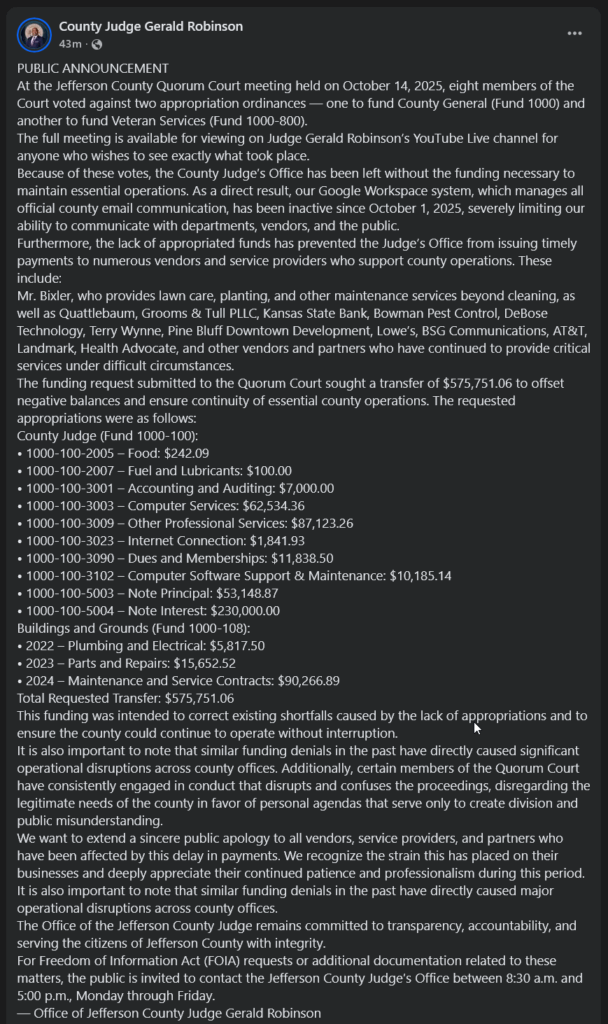
    Last night, Judge Gerald Robinson attempted to secure an additional $571,664.29 for his office to cover expenses. The Quorum Court denied the request, prompting him to post on social media this morning criticizing the decision. Below is a screenshot of his post. Let’s examine the finances of the County Judge’s Office to understand why this request was made.

    County government budgets are divided into funds, departments, and groups. For example, line 1000-100-2005 breaks down as follows:

    1000 is the fund (County General), which defines the source of the money.

    100 is the department (County Judge).

    2000 identifies the group, in this case “Supplies.”

    2005 is the specific line item, here used for food purchases by the County Judge’s Office from the General Fund.

    The balance of an individual line does not matter; only the group balance does. For example, lines 2005 and 2007 draw from the same group total. However, funds cannot be moved between groups (e.g., from 2000 to 3000) without Quorum Court approval.

    1000 Group | Personal Services

    Covers employees, benefits, and payroll.
    Original budget: $463,194.68
    Additional appropriation: $3,289.50 (bonus pay ordinance, July)
    Spent: $244,393.51
    Remaining balance: $222,090.67

    This group is well-funded and should last through the year.

    2000 Group | Supplies

    Intended for day-to-day supplies and equipment.
    Original budget: $120,600
    Spent: $32,089.96
    Remaining balance: $88,510.04

    Having 73% of this budget remaining in the tenth month suggests over-funding. It may warrant reduction next year. Despite this, Judge Robinson requested an additional $342.09 for this group, which is inconsistent with the remaining balance.

    Within this group, line 2024 (Maintenance and Service Contracts) retains $79,268.58. Robinson cited unpaid vendors such as Wayne Bixler, Beyond Clean, and Bowman Pest Control. These likely qualify under maintenance or service contracts. In fact, Bowman Pest Control has often been paid from this line. So why are these vendors not being paid now?

    3000 Group | Other Services and Charges

    This group includes services and technology purchases.
    Original budget: $159,462
    Spent: $186,754.84
    Remaining balance: -$27,292.84
    Requested appropriation: $176,523.19

    Spending a group into the negative constitutes spending without an appropriation, which is illegal.

    Key expenses:

    Line 3002 – Management Consulting: $17,812.50 to BSG Communication for phone system consulting.

    Line 3003 – Computer Services: $57,534.36, nearly all to Debose Technologies and Innovations (Elager Debose), who has a felony conviction (case 63CR-23-643). This raises questions about data security.

    Line 3009 – Other Professional Services: $87,123.26 paid to attorneys Terry Wynne, Casey Castleberry, Quattlebaum Grooms & Tull, Burt Newell, and $250 to the Chamber of Commerce.

    These legal costs—driven by Robinson’s ongoing lawsuits—have burdened taxpayers with $87,000 in legal fees. His current request seeks to transfer another $87,123.26 into this same line, which would create a $35,000 surplus for further legal spending.

    4000 Group | Capital Outlay

    Starting budget: $135,000
    Transferred in June to line 5003 (Note Principal)
    Remaining balance: $0

    5000 Group | Debt Service

    For loans and leases.
    Original budget: $672,865
    Additional appropriation: $135,000
    Total appropriation: $807,865
    Spent: $763,062.50
    Remaining balance: $44,802.50

    Major lines:

    5003 Note Principal: $67,687.87

    5004 Note Interest: $223,693.38

    5007 Simmons Bank Loan Payment: $471,681.25

    In total, $763,000 in loan payments have already been made. Yet Robinson seeks another $283,148.87 for additional payments. The county now owes over a million dollars annually on loans, likely for building projects Robinson often highlights. But if these loans were predictable, why did he budget only $672,865? He created this shortfall himself by under-budgeting.

    The Quorum Court has repeatedly sought explanations for the County Judge’s overspending, only to be met with resistance. Their role is to oversee county finances, not rubber-stamp every request. Robinson’s claim that he need not answer their questions contradicts the principle of public accountability. Thirteen Justices of the Peace were elected to ensure that accountability exists.

    Any financial problems in the County Judge’s Office are self-inflicted. Vendors awaiting payment have every right to be frustrated; but the cause lies in mismanagement, not inaction by the Quorum Court.

  • Cannon’s response to his loss

    Mark Cannon could not help but get on his live stream last night to talk about his loss of over $400,000 to Courtney Kelly in a default judgment on Kelly’s defamation lawsuit. Here’s what he said:

    “That lawsuit was filed against me I think in 2023, according to what I’ve read. But guess what, I was never served.”

    You can watch a clip of that video on our Facebook Page.

    The problem is that court documents are public information. Below you can also find a document filed with the clerk’s office that Cannon was in fact served on 6/17/2023. This documents shows that it was served to Martha Cannon, his wife, at his house.

    But let’s pretend that this is a lie for a second and that Mark Cannon had no idea that this lawsuit existed. Then why did he write the court on 8/14/2023 and ask more time to acquire legal counsel? You can’t exactly do that for a lawsuit you don’t know exists.

    It should also be pointed out that his response to the lawsuit was 27 days past the deadline to respond to it. So he was already violating the rules with this first letter.

    What lie do you want to tell the people next, Mark?

  • Cannon Fails to Defend the Fort

    Looks like Mark Cannon’s legal defense went “boom”! He just lost a lawsuit by default judgment in Jefferson County Civil Court!

    Cannon was sued by Courtney Kelly for things like slander, libel, false light, and outrage. Apparently, Mr. Cannon was quite active on Facebook, allegedly publishing false and defamatory statements about Kelly through livestreams and videos.

    Cannon failed to show up or defend himself, so the court smacked him with a default judgment. The final tally for his no-show was a whopping $408,930.48 in damages!

    You may have heard Cannon’s name recently because he announced that he plans to run for Sheriff of Jefferson County. I’d guess this judgement will hurt the ole’ campaign fund raising.

    This lawsuit isn’t over yet, though. County Judge Gerald Robinson, both in his official and individual capacity, is also a named defendant.


  • Judge Wright’s Order

    Let’s talk about the court order that County Judge Gerald Robinson keeps referencing – Judge Wright’s Court Order. You can read the full text of the order below, but here’s the part he loves to quote:

    “4. The Court finds that Jefferson County Quorum Court failed to pass such ordinance not only at its January meeting but continued to violate the clear direction of Arkansas law in subsequent meetings. The evidence presented by testimony and video centered on a meeting held on June 26, 2023. At said meeting the Court heard and saw the utter chaos and discourse of the meeting which resulted in the failed attempt to pass such ordinance. In the meeting held on June 26, 2023, the justices of peace present failed to follow basic procedure by attempting to waive formal reading of a proposed ordinance for purposes of placing the ordinance on second and third reading, and thereby allowing for the vote of the ordinance at the June 26, 2023, meeting. At the time of the vote on the suspension of the rules there were only 7 members present in the body of Jefferson County Quorum Court. The Court finds Arkansas law is clear that to suspend the rules of formal reading of the ordinance requires a 2/3 majority vote of approval by the Quorum Court as a whole, which would have required 9 members present and voting. The Court finds that the procedural ordinance, Ordinance 2023-5 was not properly presented and was not properly approved or enacted.”

    Let’s break that down into plain English:

    1. The Quorum Court didn’t pass a Rules of Procedure ordinance at its January meeting or at any meeting after that.
    2. A video of the June 26, 2023 meeting was shown to the court, where members claimed they had passed the ordinance.
    3. Only 7 of the 13 Justices of the Peace were present.
    4. Those present voted to suspend the rules to avoid reading the ordinance three separate times.
    5. Arkansas law requires 9 votes, 2/3 of the entire Quorum Court, to suspend the rules. Seven votes wasn’t enough.
    6. Because they didn’t follow the required procedure, the ordinance wasn’t properly approved.

    In short: Jefferson County hasn’t had a valid Rules of Procedure ordinance in place for all of 2023, 2024, and part of 2025.

    So, what do we do with that information? In my view, there are two options:

    1. Treat everything passed by the Quorum Court between January 1, 2023, and April 7, 2025, as invalid — every ordinance, every appropriation, voided like it never happened.
    2. Recognize the chaos that would create, move forward, and pass a new ordinance affirming the validity of actions taken during that time.

    Here’s the irony: either everything from the past two years is valid, or none of it is. Judge Robinson loves to cite Section 4 of the order when he disagrees with the Quorum Court.  But when he’s getting what he wants? Silence. If the order invalidates Quorum Court actions, then that includes the millions in appropriations made to his office. Yet he’s had no issue spending that “illegal” money; and he still asks for more every year, with nothing but excuses when the bills aren’t paid.

    One last point: Judge Wright’s order doesn’t actually order anyone to do anything. It doesn’t explain how the county should proceed without rules. It just says the ordinance wasn’t passed properly. That’s it. No commentary on how this affects county operations going forward.

    In closing, stop taking Judge Robinson at his word when he says everything the Quorum Court is doing is illegal. That’s not what the order says. Read it yourself, then call him on his nonsense.

  • Road Department Layoffs raise questions

    There’s been a lot of talk lately about the Jefferson County Road Department layoffs that took place in April of last year (Pine Bluff Commercial article). At the most recent Quorum Court meeting, Judge Robinson confirmed they would not be bringing those employees back this year.

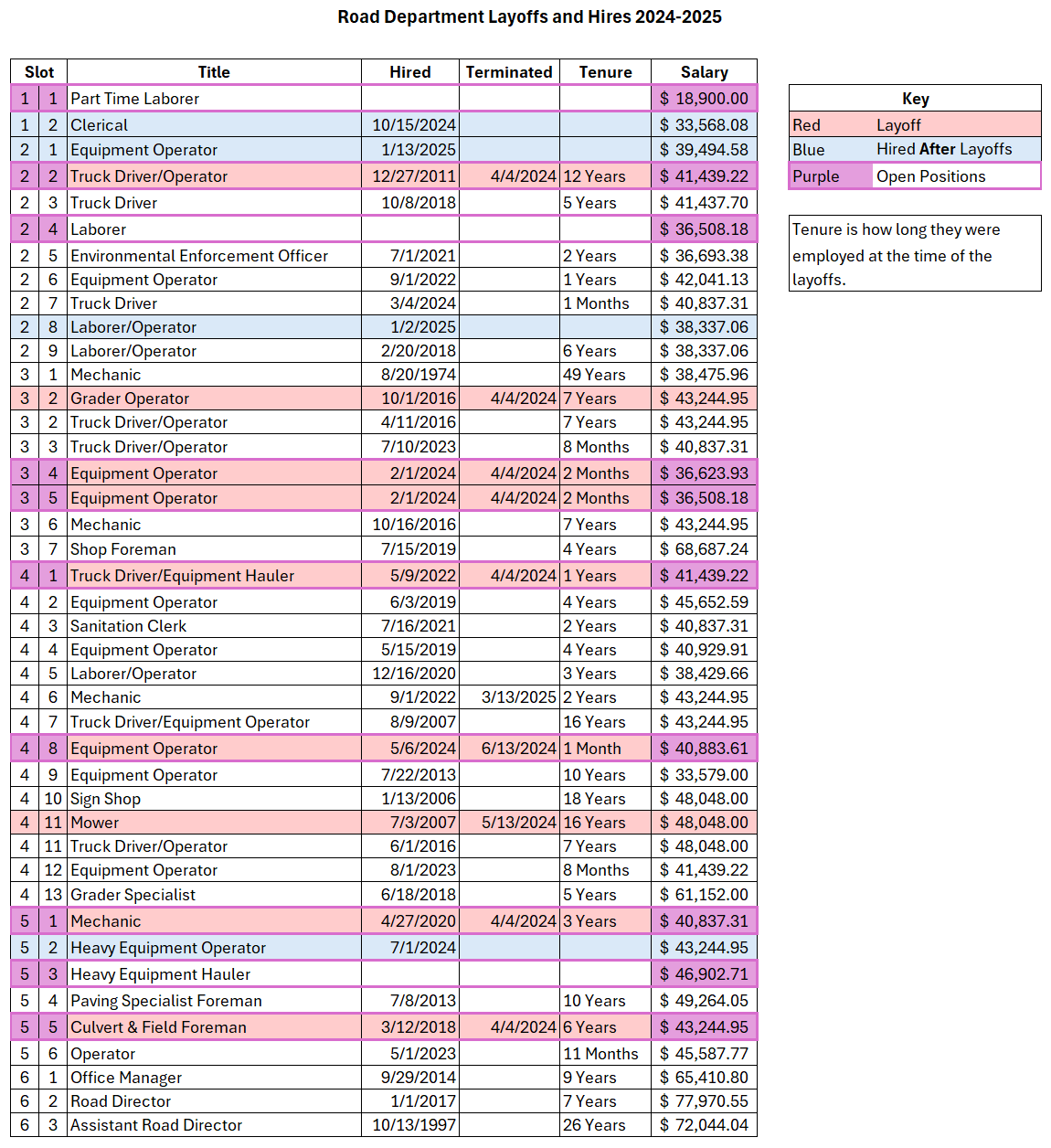
    Let’s walk through the Road Department’s employee roster using the image titled “Road Department Layoffs and Hires 2024–2025.” For privacy reasons, I’ve removed employee names. Here’s what each column represents:

    • Slot: The budget line item for that employee. The department started the year with enough funding budgeted for 40 employees.
    • Title: The employee’s job title.
    • Hired: The employee’s hire date.
    • Terminated: The employee’s termination date, whether voluntary or involuntary.
    • Tenure: How long the employee had been employed by the county at the time of termination.
    • Salary: The budgeted salary for the position (which may differ from actual pay).
    • Red highlighting: Employees who were laid off.
    • Blue highlighting: Employees hired after the layoffs.
    • Purple outlines: Currently vacant positions.

    The article states that 10 people were laid off. However, I’ve only been able to account for nine. There may indeed be a tenth, but I haven’t been able to identify them. Then there is the employee in Slot 4-8, who was hired after the layoffs (on 5/6/2024) and then terminated a month later (on 6/13/2024). That individual has spoken publicly about being included in the layoffs, so I’ll give them the benefit of the doubt and include them in the count.

    A few things stand out in this data. First, since the layoffs, the Road Department has hired four new employees. Three of these filled job titles that matched those of laid-off employees. However, none of the new hires were among those laid off.

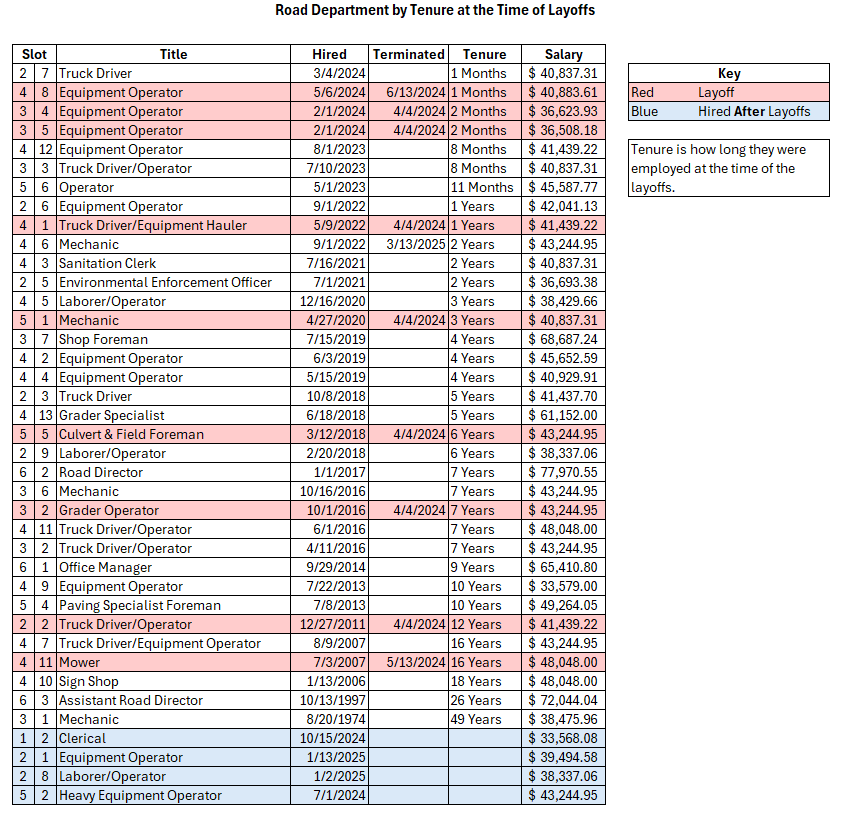
    Second, if you refer to the above image, titled “Road Department by Tenure at the Time of Layoffs,” you’ll see a breakdown of how long each laid-off employee had worked for the county. Four had been employed for less than a year, which is expected in a layoff scenario. What’s surprising is that the remaining five had been with the county for three to sixteen years, combining for a total of 44 years of service. How does it make sense to let go of employees with over a decade of experience while keeping those who were barely a year in?

    I’m not an expert in heavy equipment operations or Road Department logistics. But to me, it seems like those long-serving employees would have been worth retraining or reassigning. If I were a conspiracy theorist, I might suspect that this wasn’t truly about budget cuts, but rather a convenient way to remove people who were no longer favored, without having to justify it.

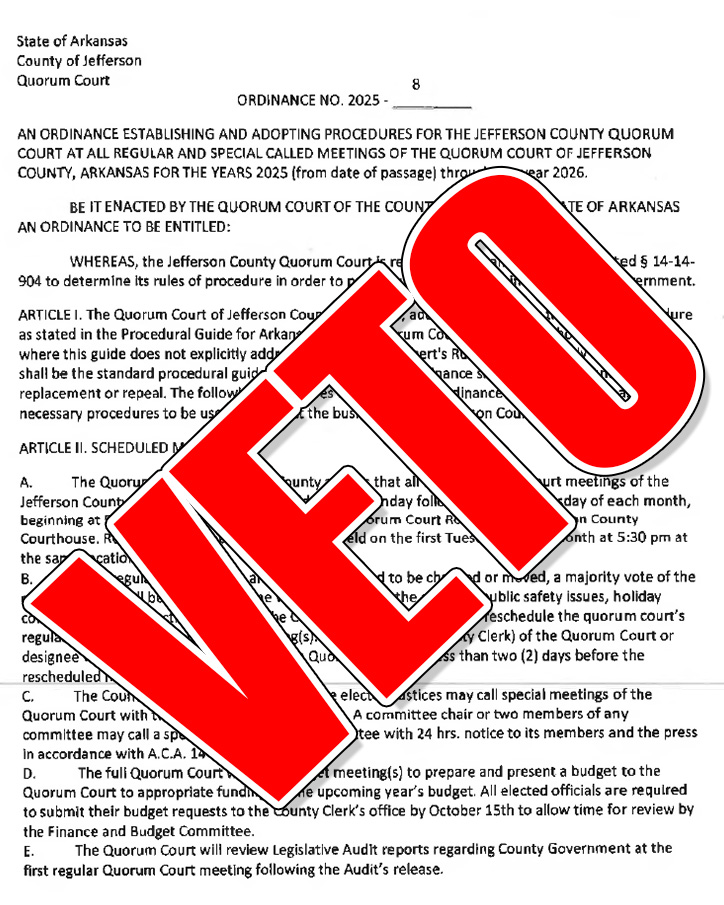
  • County Judge Vetoes Procedure Ordinance

    On March 17, 2025, the Quorum Court met and passed a Rules and Procedures ordinance. This ordinance outlines how the Quorum Court conducts itself and passes other ordinances. It’s required by law and is the first step toward passing a budget – something that should have been done before January.

    On March 20, 2025, County Judge Gerald Robinson vetoed the ordinance.

    Judge Robinson’s veto stated: “Out of an abundance of Caution and because of numerous attempted violations of separation of authority, and Information violation. I hereby Veto Ordinance 2025-8.”

    I’ve linked Judge Robinson’s letter and the vetoed ordinance below.

    So, what’s the County Judge’s issue with the ordinance? Simply put, it limits his control over legislative matters – control he shouldn’t have in the first place. The County Judge represents the executive branch of our local government. The Justices of the Peace make up the legislative branch. They hold all the legislative power, except for the ability to veto, which belongs to the Judge.

    But under Judge Robinson’s version of the Rules and Procedures ordinance, he would control which ordinances the court is even allowed to vote on. He could stack committees so that if something he disagrees with makes it to a vote, his five-member “goon squad” could kill it before it ever reaches the full court.

    So, when he goes on the radio and blames the majority of the Quorum Court for trying to strip him of power, know that they’re simply working to keep the County Judge in his lane. He can’t legislate, and they can’t execute. But he wants all the power of all branches of government – and that’s not how this works.

  • Rules and Procedures 2025

    This will be a long post, but it’s important for the public to be informed about what is happening in their government. Today, I’m sharing a copy of Judge Gerald Robinson’s proposed Rules and Procedures ordinance. This ordinance may be the most important legislation the Quorum Court passes every other year. Once adopted, it becomes the law by which the Quorum Court operates, dictating how meetings are conducted and how other ordinances (laws) are presented and passed. I will also explain the issues I see with this ordinance and share a version I’ve prepared that I believe addresses those problems.

    The first thing to note is that this ordinance is very similar to previous versions passed in our county. However, the problem we’re facing now is that the County Judge has begun abusing these rules, making it nearly impossible for the Quorum Court to function. By manipulating these procedures, the Judge and only five Justices of the Peace have been able to stop the work of our county government—against the will of the other eight Justices and all of the county’s elected officials. That’s not how any of this is supposed to work.

    Let’s start with Article II, Section (c):

    “The agenda for the regularly scheduled committee meetings, quorum court meetings, and public hearings shall be determined by the County Judge, reduced to writing and delivered to the Justices of the Peace at least forty-eight (48) hours in advance.”

    This language once caused no issues. After all, someone has to gather, prepare, and distribute ordinances and agendas. But here’s the problem: this gives a member of the Executive Branch—the County Judge—full authority to set the Quorum Court agenda. By controlling the agenda, he controls what the court is allowed to discuss and vote on. This is why the court is repeatedly forced to vote on his version of the budget, not the version supported by the majority of the Quorum Court and all of the other elected officials.

    The Arkansas Association of Counties publishes the Procedural Guide for Arkansas County Quorum Court Meetings, which this ordinance “adopts in its entirety” under Article I. Here’s what the guide says about the agenda:

    “The specific nature of matters to be considered at quorum court meetings should be indicated in an agenda prepared and furnished members of the quorum court in advance of the meeting. By knowing explicitly what they will be called upon to decide, efficiency of the quorum court is increased, and members will come to each meeting better prepared for decision making. Since the agenda is primarily set by the quorum court members, procedures must be established covering agenda preparation. Procedures should include: Identification of the office or individual, e.g., county clerk or secretariat of the quorum court, to whom quorum court members will submit items they wish to be included on the agenda for the next meeting; the deadline for submitting agenda items; and, the deadline for having the completed agenda in the hands of the quorum court members and the county judge.”

    A key part of this is “Since the agenda is primarily set by the quorum court members…” That clearly identifies who should control the agenda. It’s unreasonable that the Legislative Branch of our local government has no agency over what they discuss and what legislation they vote on.

    Here’s how I propose rewriting Article II, Section (c) to restore that power:

    “The agenda for the regularly scheduled committee meetings, Quorum Court meetings, and public hearings shall be prepared by the County Judge, reduced to writing, and delivered to the Justices of the Peace at least ninety-six (96) hours prior to the meeting. All proposed items to be considered by the Quorum Court at the regular monthly meeting shall be submitted in writing or emailed to the County Judge. Once submitted, the County Judge or his designee shall assign them to an appropriate committee of the Quorum Court for consideration. Each request shall have at least one (1) Quorum Court member listed as a sponsor.”

    This language ensures the County Judge handles preparation and distribution of the agenda but does not control what items appear on it. The members of the Quorum Court have the right to decide what legislation they will consider.

    Next is Article II, Section (f):

    “The County Judge shall create any new committee as he sees fit, appoint committee members to all committees, and appoint all chairpersons of committees.”

    Why is this a problem? Because in Jefferson County, before anything reaches the full Quorum Court, it must pass through committee–often two committees. We have four standing committees: Public Safety Committee, Human Resources Committee, Judicial Committee, and Finance and Budget Committee.

    Typically, an ordinance goes through one of the first three, and if it passes, it moves to Finance and Budget. The issue is that most—or sometimes all—of these committees are stacked with the same five Justices of the Peace that are loyal to the County Judge. They vote down anything the Judge opposes and block legislation from ever reaching the full Quorum Court.

    Here’s how I propose changing this rule:

    “The County Judge shall create committees and appoint committee members to all committees as necessary, subject to the following rules:

    1. Committee assignments shall be distributed as evenly as possible among all Justices of the Peace. No Justice of the Peace shall serve on more than one committee greater or fewer than any other Justice of the Peace.
    2. The four standing committees for the years 2025–2026 are as follows: Finance and Budget Committee, Public Safety Committee, Human Resources Committee, and Judicial Committee. Each committee shall have no fewer than six members.
    3. A vote by a majority of the full Quorum Court shall be required for an item to bypass committee and go directly before the full court. This vote can be called by motion of any committee member during the committee meeting. If a quorum of the full Quorum Court is not present when the vote is called, the item shall be tabled until the next scheduled Quorum Court meeting.”

    This rule maintains the County Judge’s appointment authority but ensures fair distribution of committee assignments and prevents any single group from blocking legislation.

    The County Judge may claim that these changes infringe on powers granted to him by the state constitution. They do not. What we’re actually doing is restoring the Quorum Court’s ability to function as the law intends. The County Judge has no legislative role beyond the ability to veto ordinances passed by the Quorum Court.

    But Judge Robinson appears to believe he is more akin to a king of Jefferson County rather than a county administrator. He does not rule the Quorum Court, and he is not the boss of any other elected official.

    I’ve attached my suggested version of the Rules and Procedures ordinance. In addition to the two key changes above, I’ve included a requirement that the County Judge post all meeting agendas and supporting documents on the Jefferson County website. Transparency in government should always be a top priority.